Selling a Business That Owns Its Building: Your Three Options
When a business owner who also owns the real estate decides to sell, the deal immediately becomes more complex, and more valuable, than a standard business sale. The question is not just what the company is worth. The question is what the company is worth, what the building is worth, and how the two interact in a sale structure.
Most advisors approach this problem the wrong way. They treat the business sale as the primary transaction and the real estate as a detail to sort out later. That approach consistently leaves money on the table and creates tax complications that could have been avoided with proper upfront planning.
If you own the building your business operates from, you have three structural options when you sell. Understanding all three before committing to a path is the difference between a good outcome and a great one.
Option 1: Include the Real Estate in the Business Sale
The simplest path: sell the business and the building together as one transaction. The buyer acquires the operating company and the real property under a single purchase agreement, with the purchase price allocated between the two asset classes.
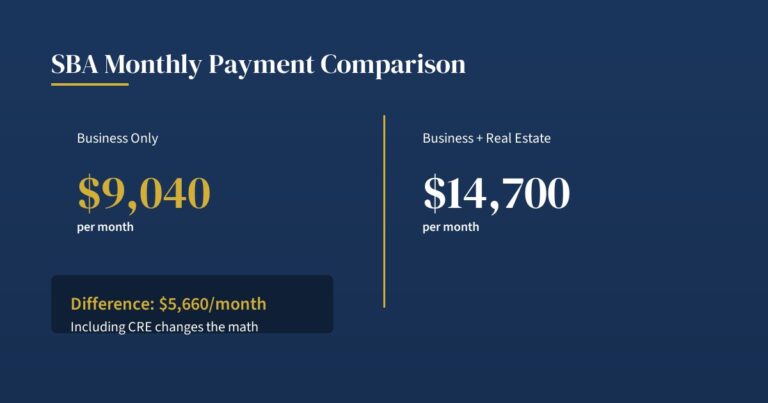
This structure works well when the buyer wants the real estate and has the financing to support it. SBA buyers in particular often benefit from this approach, because including real estate in an SBA 504 loan allows them to finance the property over 25 years rather than 10. That longer amortization period significantly lowers monthly debt service and improves cash flow for the new owner, which in turn supports a higher purchase price for you.
The complication is purchase price allocation. When a business and real estate are sold together, the IRS requires the parties to allocate the total purchase price across asset classes: tangible assets, intangible assets, goodwill, and real property. How you negotiate that allocation affects capital gains treatment for the seller and depreciation schedules for the buyer. These interests are not always aligned, and the allocation negotiation can be contentious if not addressed early in the deal.
Best when: The buyer is SBA-financed and wants the real estate, the property is integral to the business operations, and you prefer a clean single-close transaction.
Option 2: Separate and Sell Simultaneously
The business and the real estate are sold in separate transactions that close at the same time or within a short window. The business buyer acquires the operating company. A separate commercial real estate buyer or investor acquires the property. Both deals are structured independently but coordinated in timing.
This structure often produces higher total proceeds because each asset is marketed to the buyer universe best suited for it. PE buyers and strategic acquirers frequently prefer to buy the business without the real estate, since they do not want to own and manage property. Commercial real estate investors who value the property as a standalone investment, particularly if there is a long-term lease in place, may pay a premium that a business buyer would not.
The complexity is coordination. Running two parallel sales processes requires experienced advisors on both sides and careful attention to timing, contingencies, and the lease terms that will govern the relationship between the new business owner and the new property owner.
Best when: Your target business buyer is PE or strategic and prefers not to own real estate, the property has investment value independent of your business, and you want to maximize total proceeds across both assets.
Option 3: Sale-Leaseback
You sell the operating business to a buyer, but you retain ownership of the real estate and lease it back to the new owner under a long-term commercial lease. You collect rent as a landlord while the new owner operates the business as your tenant.
This structure is often the most financially powerful for sellers who have significant equity in a property that would generate strong, predictable rental income. You capture the full value of the business sale while converting the real estate into an ongoing income stream. For owners with retirement planning objectives, owning a triple-net commercial property leased to a creditworthy operating business is an attractive long-term asset.
The risk is lease dependency. The value of the real estate you retain is tied to the financial health of the business operating in it. If the new owner struggles, the tenancy and your rental income are at risk. Strong lease terms, security deposits, and careful buyer selection mitigate this risk but do not eliminate it.
Best when: You want long-term income from the real estate, the property is well-located and would hold value independent of your specific business, and you are confident in the buyer’s ability to sustain operations.
The Variable Most Owners Miss: SBA Financing Changes the Math
An SBA 7(a) loan used for a business acquisition without real estate typically has a 10-year term. The same deal structured as an SBA 504 with owner-occupied real estate can use a 25-year term for the real estate component. The difference in monthly debt service on a $2M real estate acquisition between a 10-year and a 25-year amortization period, at current rates, is roughly $7,000 to $9,000 per month. That cash flow improvement directly supports a buyer’s ability to service more total debt, which supports a higher offer.
Tennessee-Specific Considerations
Tennessee has a deed transfer tax of $0.37 per $100 of consideration for real property transfers. At a $2M property, that is $7,400 in transfer taxes, typically allocated to the seller by custom. Tennessee also has favorable 1031 exchange treatment for sellers who want to defer capital gains on real property by reinvesting in like-kind real estate. If the property has appreciated significantly, a 1031 exchange into a new investment property may offset a substantial tax liability.
The Most Common Mistake
The most expensive mistake business owners with real estate make is letting the real estate dictate the deal structure instead of the other way around. They say things like “I’m going to keep the building” before they have modeled what each option actually produces in net proceeds. Icon models all three paths before recommending one.
Related Reading
- SBA 7(a) vs. SBA 504: Which Loan Wins When Buying a Business with Real Estate
- Sale-Leaseback for Business Owners
- Icon Commercial: Commercial Real Estate Advisory for Business Owners
Talk to Icon About Your Real Estate Strategy
If your business owns its operating real estate and you are thinking about a sale in the next one to five years, schedule a no-pressure call with Daniel Askew to walk through your specific situation.