
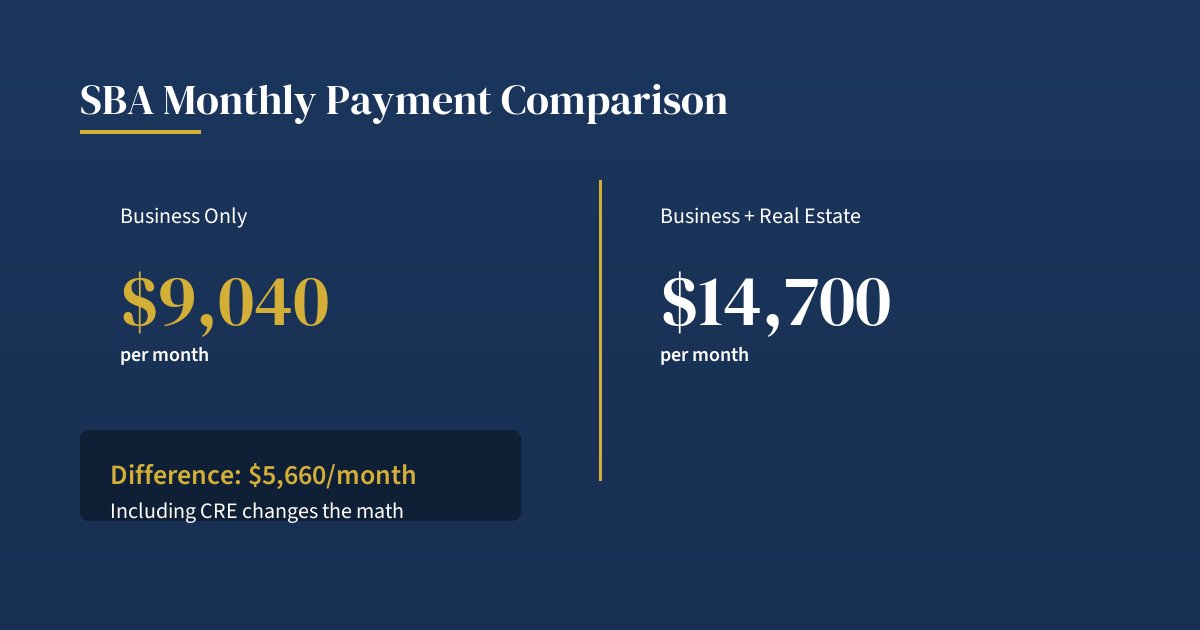
How Including Real Estate in an SBA Deal Changes Your Monthly Payment by $7,000
One of the least understood variables in buying or selling a business with real estate is how the financing term on the property affects the buyer’s total debt service, and by extension, what they can afford to offer you. SBA loans used for business acquisitions without real estate are typically structured on 10-year terms. When owner-occupied commercial real estate is included, the same SBA programs allow the real estate component to be amortized over 25 years. That 15-year difference in term produces a monthly payment gap that directly affects deal economics for everyone at the table.
The Actual Numbers
Consider a $2 million commercial real estate component in a business acquisition at a 7.5% interest rate:
10-year term: $23,780 per month. Annual debt service: $285,360.
25-year term: $14,740 per month. Annual debt service: $176,880.
The monthly difference is $9,040. The annual difference is $108,480. Over five years, the buyer who financed over 25 years has $542,400 more in cumulative cash flow than the buyer who financed over 10 years on the same $2 million property.
Why This Matters for Sellers
Buyers make offers based on what they can afford to service after debt. A buyer running a 10-year amortization on the real estate needs more EBITDA coverage to justify the same purchase price as a buyer running a 25-year amortization. The seller who structures their deal to include real estate in an SBA transaction may be creating a meaningfully more competitive auction simply by making better financing available to their buyers.
Working Backward from the Monthly Payment
When advising on a business sale with real estate, Icon models the buyer’s total debt service under multiple scenarios: business only, business plus real estate on a 10-year term, and business plus real estate on a 25-year term. The scenario that leaves the buyer with the strongest post-debt-service cash position typically produces the most competitive offer. Understanding that math before you go to market is the difference between a reactive seller and a strategic one.
Related Reading
- SBA 7(a) vs. SBA 504: Which Loan Wins for Business Acquisition
- The 51% Rule: SBA Owner-Occupancy Requirements
- Icon Commercial: Commercial Real Estate Advisory for Business Owners
Want to Model the Financing Scenarios for Your Deal?
Icon builds side-by-side financing models for business sales with real estate as part of every engagement. Reach out to talk through how your property structure affects your buyer pool and your net proceeds.